
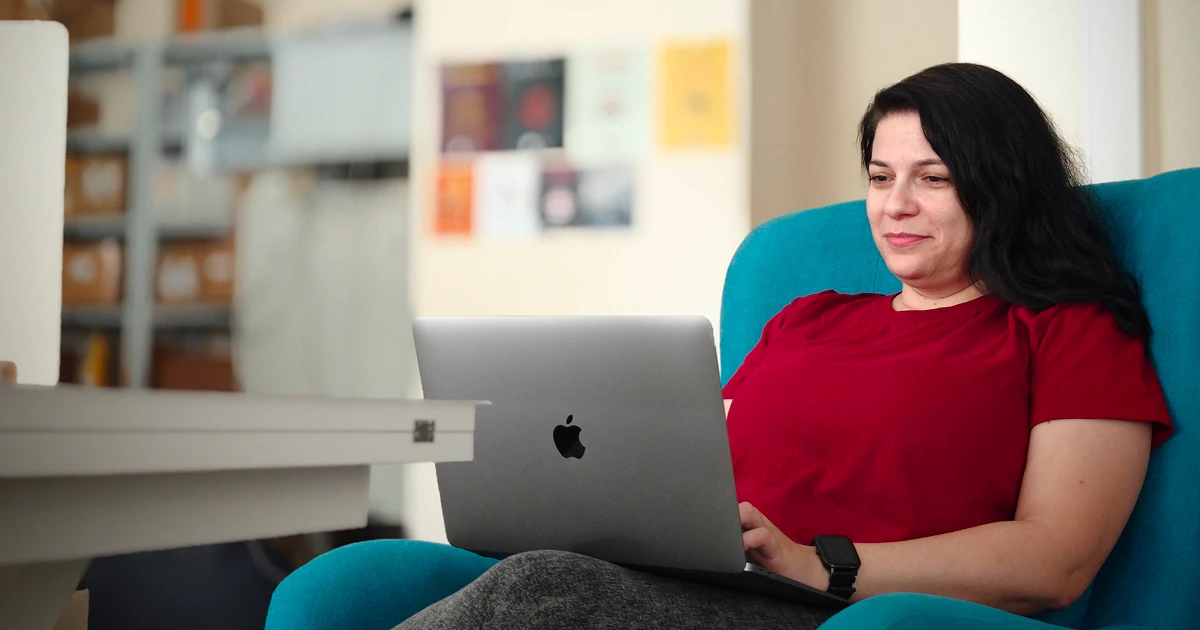
Before Yulia wrote a line of production code, she did something that sounds nothing like software and turns out to be surprisingly close. She was a psychologist. She sat with people, listened to what they said and to what they could not quite put into words, and helped them make sense of complicated situations. Today she does much the same thing, except the complicated situations are systems, and the people include both our clients and the users they build for.
Why we hired for it
At a lot of studios, “trained psychologist” would be a quirky line on a bio page. At Femmesoft it is closer to a hiring thesis. We have always believed the hardest part of building software is rarely the code. It is understanding what a business actually needs, hearing the real problem underneath the request, and keeping people aligned when a project gets difficult. Psychology trains exactly those skills: careful listening, good questions, and patience with uncertainty.
Yulia made the move from psychology to software on her own, entirely self-taught. Today she works across the stack, from the interfaces people actually touch to the APIs and data models underneath them.
The question behind the question
What stands out is not just that she ships clean work, but how she gets there. She asks the question behind the question, notices when a requirement does not add up, and translates between what a client says and what they mean.
That translation is where a lot of projects quietly fail. A spec is rarely just a spec. It is someone’s hope for their business, written down in a hurry. Yulia reads both. A typical moment: a client asks for a bigger filter panel because “users can’t find anything.” Before touching the code, Yulia asks what users are actually looking for, and often it turns out most of them want the same three things. The answer is not more filters but a shorter path to those three things.
“Psychology taught me to listen for what people aren’t saying,” Yulia says. “Code is no different. The real problem is rarely where it first shows up.”
Why this is on purpose, not an accident
Her story is also why we are a women-led team on purpose, not by accident. The best people do not always arrive by the straight path, and some of the sharpest engineers we know started somewhere else entirely. We tend to our clients’ products as if they were our own, and we befriend the people behind them. It helps to have someone on the team who has spent a career understanding people first, and learned to code second.